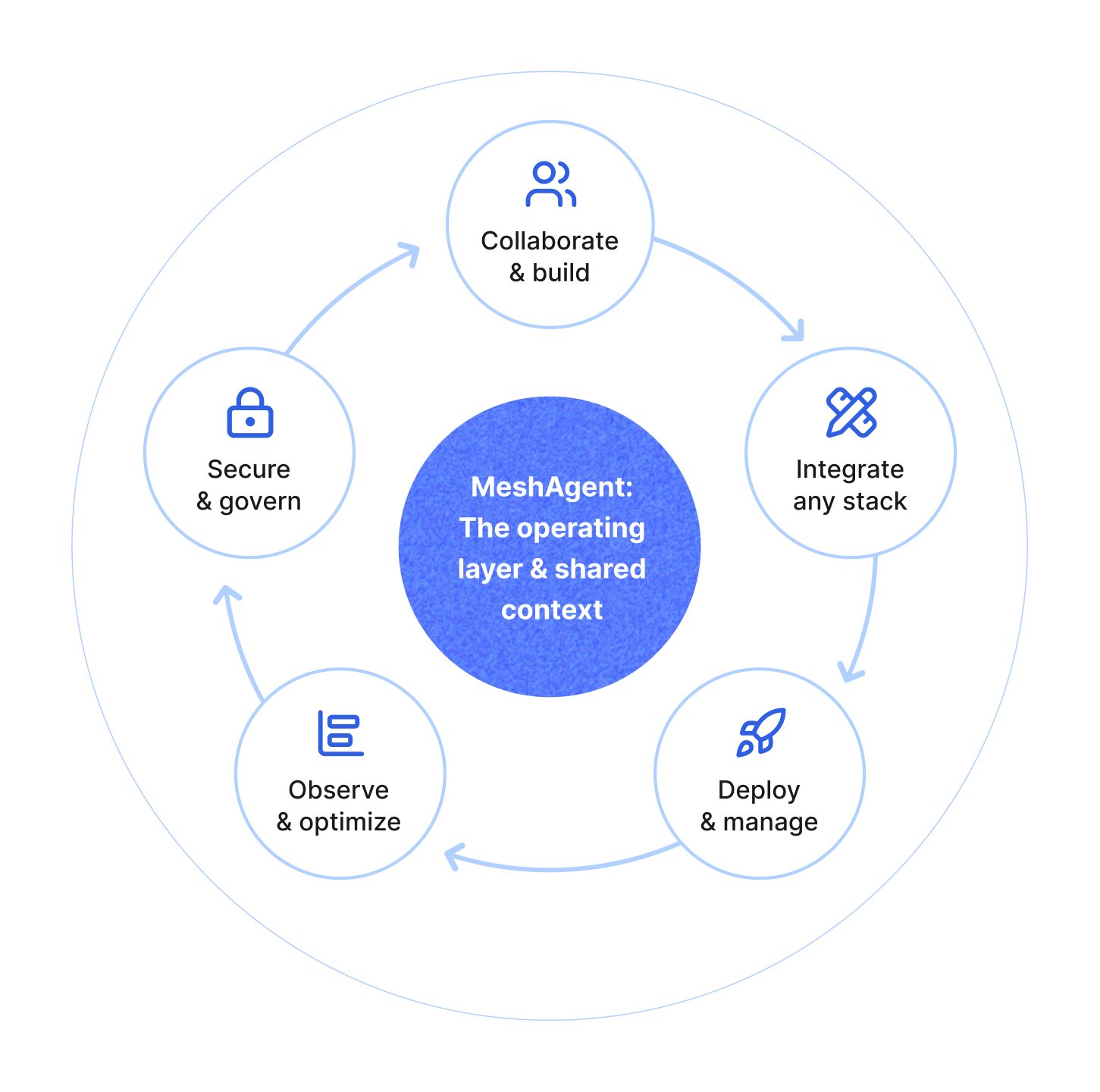
MeshAgent 0.35 focuses on two practical improvements: a more consistent secrets model across projects and rooms, and new workflows for packaging and building room services directly in MeshAgent. It also extends that secrets model to external OAuth registrations at both project and room scope.
MeshAgent already supported both project secrets and room secrets, but they served different workflows and were handled through different APIs.
In 0.35, those paths become much more consistent. Project- and room-scoped secrets now use matching managed secret APIs, shared models across the SDKs, and the same base64-backed payload format. External OAuth client registrations are also supported at both project and room scope.
That matters when a team has credentials that belong at different levels. A shared API credential can stay at the project level, while room-specific credentials can live with the room itself, without forcing a different mental model for each case. It also gives SDK users a clearer path for delegated secret access and OAuth configuration as services move from setup into day-to-day operation.
On the SDK side, Python, Dart, TypeScript, and .NET all pick up the managed secret model in this release, and older helpers now resolve through the new managed secret APIs rather than through a separate compatibility path.
MeshAgent 0.35 also introduces two new CLI workflows for container images: `meshagent image pack` and `meshagent image build`.
`meshagent image pack` can package a local directory as an OCI image archive. `meshagent image build` can upload packed build context into room storage, build the image inside a room, and optionally deploy the result as a room service.
The practical shift is that image creation can now happen much closer to where the service will actually run. Instead of treating image packaging as a separate step outside MeshAgent, teams can move from local source code to a built room service through the same platform workflow. That is especially useful for shared environments, for teams that do not want to depend on a local Docker daemon, and for deployment flows that need to be easier to reproduce across contributors.
This release also expands SDK coverage around room memory. The memory system already existed, and 0.35 makes more of that surface available directly from Dart and other SDK clients with typed operations for inspect, query, ingest, recall, delete, and optimize.
Studio and the Dart UI layer also pick up practical quality-of-life changes. Teams can control whether completed tool-call events stay visible in chat transcripts, room connections avoid duplicate connect calls and wait for the connect response before JWT setup, and the file browser now supports folder creation, tracks the active folder, and hides placeholder files.
On the runtime and operations side, live turn messages now carry sender context and ISO timestamps, chat shutdown is cleaner, diagnostics around tool failures and unsupported arguments are more detailed, and GCS support gains Workload Identity and more consistent bucket-based configuration. Router tooling also adds a migration flag for legacy Kubernetes secrets and a GCS rsync utility for provisioning buckets and running storage copy plans.
Join our Discord Server to stay up to date with MeshAgent releases, see full release notes, ask questions, and share feedback with our team.
Check out the MeshAgent documentation to start building today!

MeshAgent Studio, SDK, and Server give you everything to build, test, and deploy agentic applications, from development to production.