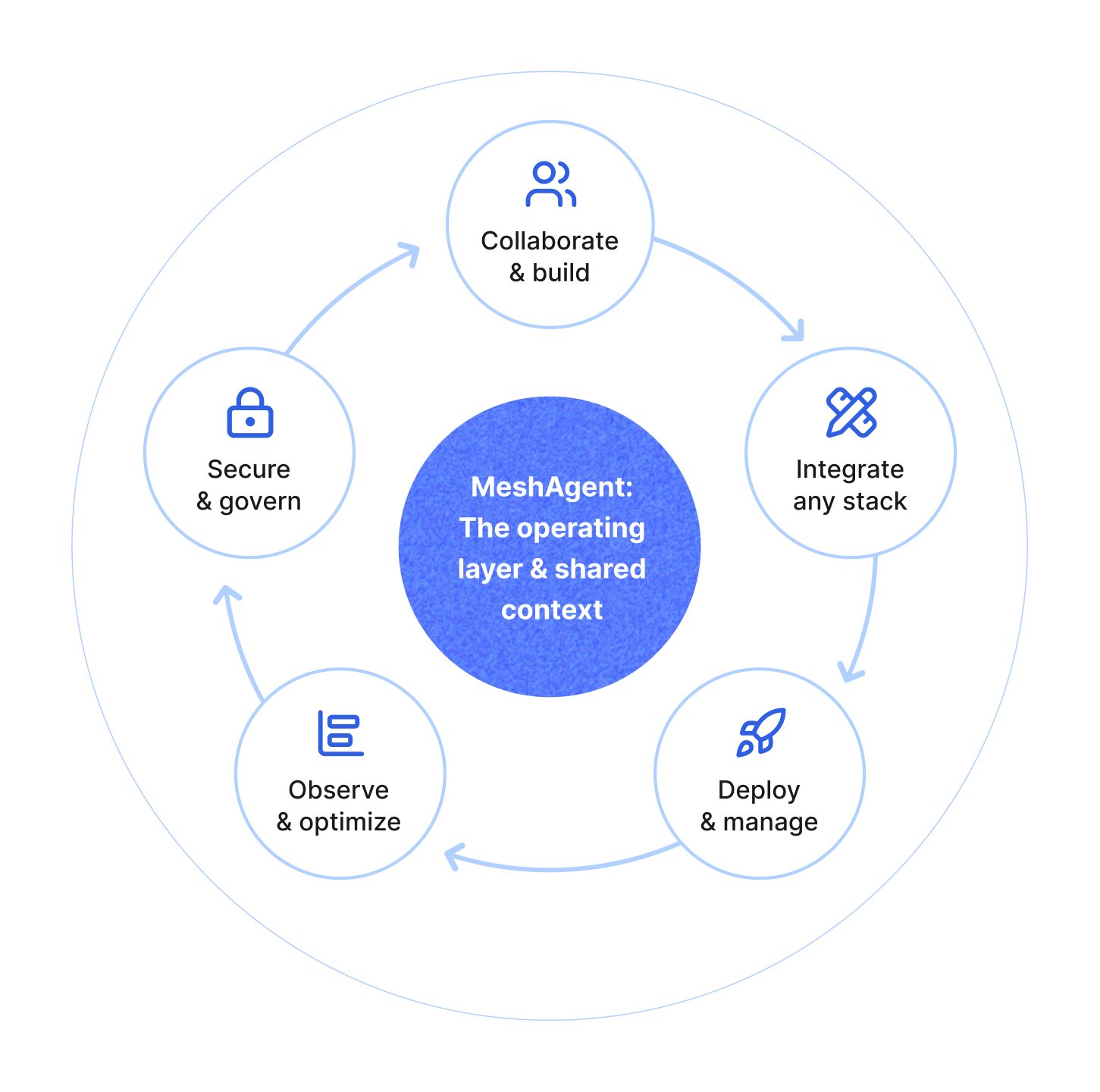
MeshAgent 0.30 introduces a major platform shift toward toolkit-based APIs with streaming operations, along with expanded container and service tooling, stronger cloud storage support, and smoother MeshAgent Studio workflows.
Across the SDKs, CLI, and Studio, 0.30 moves more of the platform toward first-class streaming operations and a unified toolkit model for interacting with room capabilities. The result is a system that handles large payloads more cleanly, exposes more room functionality through consistent APIs, and makes advanced workflows like container management and in-room image handling much easier to build on.
The biggest change in 0.30 is the move to toolkit-based tool invocation. Across SDKs, tools are now invoked through toolkits using APIs like room.invoke and room.invoke_tool, replacing older legacy invocation patterns.
MeshAgent now exposes room capabilities through a more consistent toolkit model, which makes built-in functionality easier to discover, easier to compose, and easier to extend across languages. It also creates a cleaner foundation for streaming operations, since tool calls can now carry chunked inputs, streamed outputs, and intermediate events in a more uniform way across Node, Python, Dart, and .NET.
Because this changes how tools are invoked, it is also one of the major breaking changes in the release.
MeshAgent 0.30 expands streaming I/O across the platform. Storage now uses streaming upload and download APIs instead of older handle-based write flows, and download URLs are now part of the model as well. Database, search, and sync operations also now support streaming and chunked reads and writes.
This matters most in the places where large files, large queries, or large updates used to create extra friction. Streaming operations improve responsiveness, reduce the need to buffer everything at once, and give both SDKs and MeshAgent Studio better primitives for handling larger workloads.
In practice, 0.30 makes large payload workflows feel more natural and more reliable, whether you are moving files, inserting big datasets, or rendering results progressively in the UI.
Containers and services get a substantial upgrade in 0.30. New containers clients support lifecycle operations, image management, exec flows, and log streaming. A new services toolkit also makes it possible to list and restart room services directly through toolkit APIs.
This release also adds support for building images in-room and referencing images saved locally to the room. That opens up new workflows where build artifacts and runtime images can live closer to the room context itself, instead of being treated as external deployment concerns.
Together, these changes make MeshAgent more capable as an operational platform for not only agents, but also vibe-coded apps, and other sophisticated agentic applications.
Studio now benefits directly from the new streaming architecture. File workflows use streaming uploads and download URLs, which improves how file transfers behave in practice. Database UI flows now stream inserts and search results and chunk large writes, making database operations feel more responsive and more resilient.
Studio also adds an OTEL filter endpoint and bearer token configuration, which gives teams more control over how observability data is routed and secured.
MeshAgent 0.30 includes important improvements for agents and runtime workflows as well. Thread indexing and configurable worker threading have been added, giving teams more control over how threaded work is organized and resumed. Initial message summarization and task runner behavior have also improved.
The computer tool is more flexible in this release too, with support for configurable dimensions, a starting URL, optional goto behavior, and storage-backed screenshots. These changes make browser and computer-use workflows easier to control and manage.
Cloud storage support is also stronger in 0.30. GCS and Supabase providers now have better metadata and stat handling, along with improved error mapping. These changes reduce friction when working across different storage backends and make behavior more consistent across environments.
On the observability side, OTEL proxy filtering and redaction are now supported, with optional Presidio-based PII detection. That gives teams stronger tools for protecting sensitive data while still collecting useful telemetry.
The CLI continues to expand alongside the platform changes in 0.30. Storage, containers, database, and memory tooling have all improved. Storage commands are now more folder-aware, including better ls, cp, and show behavior, and they support streaming transfers more effectively.
This release also adds new image build, push, save, and load commands, along with bug fixes for storage cp and ls. As more of MeshAgent shifts toward streaming and toolkit-based APIs, the CLI is evolving with it to expose those capabilities in a more consistent way.
MeshAgent 0.30 also updates key dependencies, including openai to ~2.25.0, and adds async ^2.13.0 to the Dart SDK.
Join our Discord Server to stay up to date with MeshAgent releases, ask questions, and share feedback with our team.
Check out the MeshAgent documentation to start building today!

MeshAgent Studio, SDK, and Server give you everything to build, test, and deploy agentic applications, from development to production.