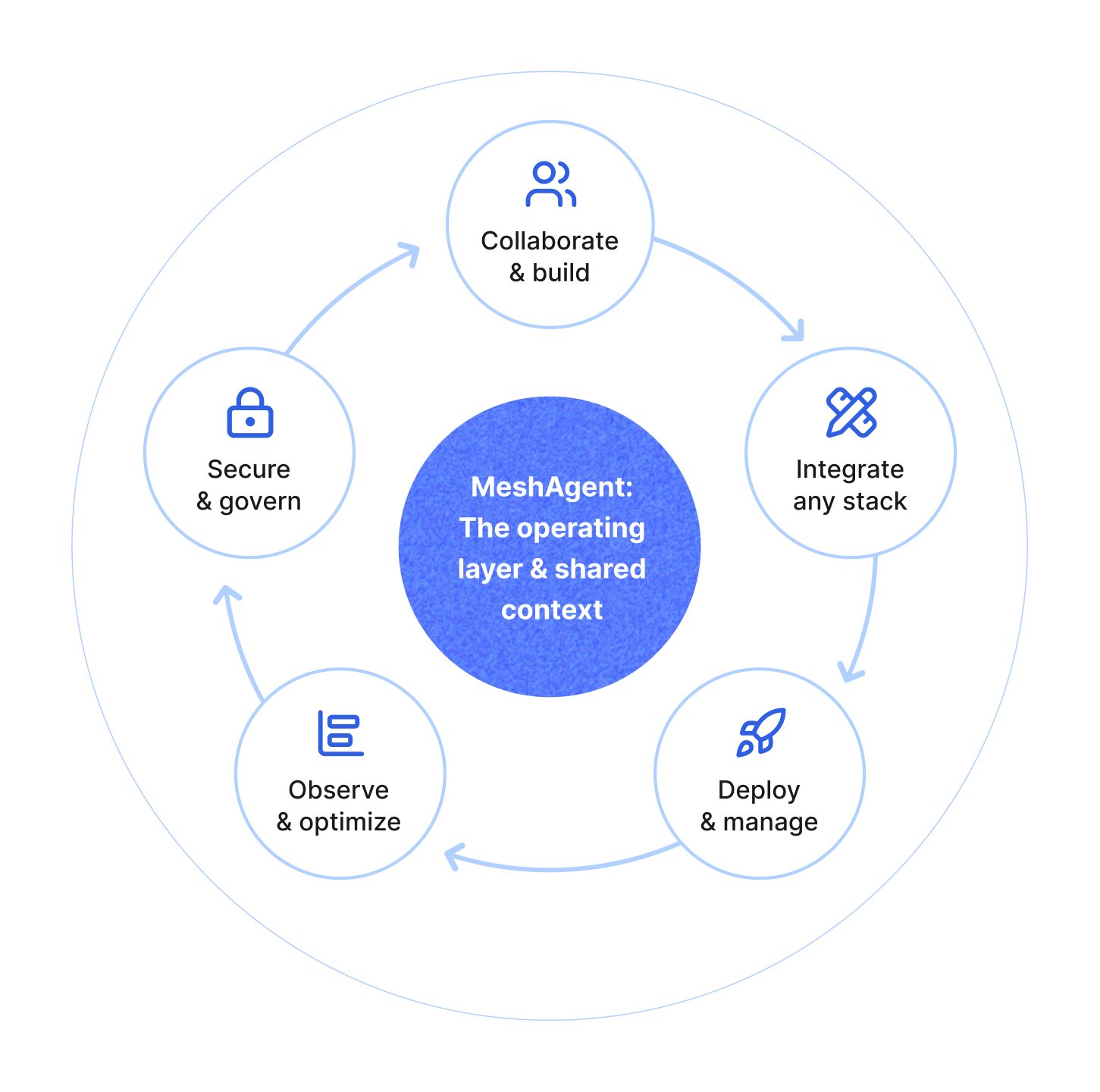
MeshAgent 0.24 simplifies how agents communicate and collaborate. This release removes legacy agent APIs, refactors the TaskRunner to expose agents as tools, and introduces finer-grained control over per-task model selection. It also expands mailbox and scheduled task management to all room members, not just creators.
The result is a cleaner, more consistent mental model with fewer APIs, clearer coordination patterns, and more powerful multi-agent composition.
In 0.24, we’ve removed the legacy agent registration, ask, and list APIs. Instead, agent coordination now happens through three clear and intentional patterns:
Previously, there were multiple overlapping ways to discover and interact with agents, which made it harder to reason about how systems fit together. Now, agents are discovered through the messaging API and as remote participants in a room, and you choose the coordination pattern (message, queue, or tool) based on the interaction you need. This simplification makes building agent systems with MeshAgent easier to design, debug, and scale.
TaskRunners are now exposed as tools, allowing them to be used directly by other agents as subagents. Execution flows through RunTaskTool and RemoteToolkit, with a new TaskContext object replacing the old AgentCallContext.
This means agents like the ChatBot and MailBot can now call another TaskRunner agent as a tool. This streamlines building multi-agent systems where agents delegate work, chain capabilities, or specialize in specific tasks.
We’ve also added the allow_model_selection parameter to LLM task runners. This gives you control over model choice on a per-task basis, making it easier to:
The Python SDK now includes a new run() helper, and the CLI adds task-runner run, allowing you to execute a TaskRunner directly. This means you’re not limited to invoking a TaskRunner only as a tool. You can now also run tasks directly from scripts or trigger them immediately from the CLI for testing and debugging.
Mailboxes and scheduled tasks are no longer restricted to their original creators. Room members and owners can now read and manage them as well.
This change reflects how teams actually work. Mailboxes and scheduled tasks are often shared resources, not just personal ones. By scoping access to the room anyone with appropriate permissions can inspect or update existing mailboxes and scheduled tasks.
In MeshAgent Studio, mailboxes are now clearly listed per room, and create/edit flows are locked to the room context. This makes ownership and visibility more explicit.
To reflect these architectural changes, the Studio UI has been simplified:
Join our Discord Server to stay up to date with MeshAgent releases, see full release notes, ask questions, and share feedback with our team.
Check out the MeshAgent documentation to start building today!

MeshAgent Studio, SDK, and Server give you everything to build, test, and deploy agentic applications, from development to production.